




We Always Focus On Optimizing the User Experience Of Our Products
1. Stable Feeding Performance
Delivers even and continuous material supply, avoiding material blocking to keep steady production.
2. Strong Bearing Capacity
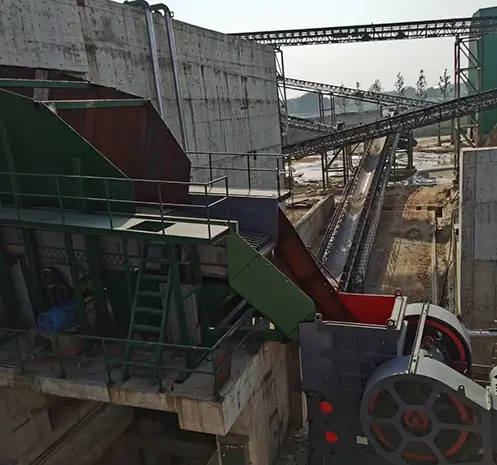
Solid structure bears heavy bulk materials, adaptable to various harsh working conditions.
3. Energy Saving & Low Noise
Low power consumption design, runs smoothly with little noise and vibration.
4. Easy Installation & Maintenance
Compact layout, simple structure, convenient daily inspection and part replacement.
Working Principle
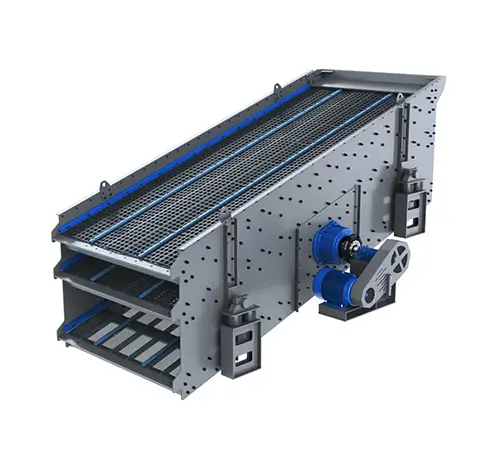
The vibrating feeder uses two identical vibrating motors operating synchronously in opposite directions to generate a directional excitation force. When the eccentric blocks of the motors rotate, centrifugal force is generated, which, at specific phases, superimposes or cancels out, causing the machine body to vibrate forcefully on spring supports. The material then slides and is thrown along the inclined trough surface, moving continuously forward and achieving uniform feeding.
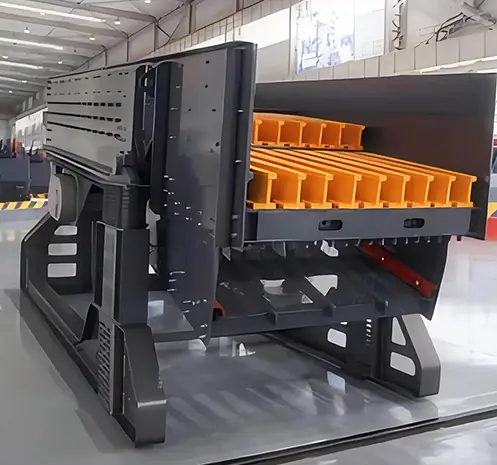
When the material passes through the bars or grates at the discharge end, finer materials smaller than the gaps can fall directly, serving as coarse screening; if screening is not required, a flat plate structure can be used.
Product Structure
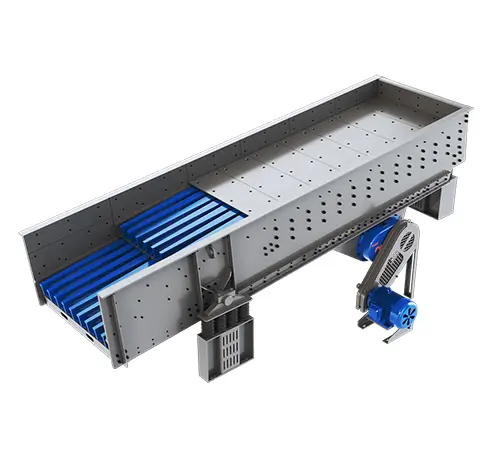
The vibrating feeder mainly consists of the following components:
1. Feeding trough: Bears and conveys materials, available in steel plate and grate structures;
2. Vibrating motor: Provides excitation force, can be installed as an upper or lower vibrating type.
3. Spring system: Includes metal helical springs or composite springs, used for vibration damping and stable operation;
4. Spring supports: Support the entire machine and buffer the foundation load;
5. Grate/bars: Enable pre-screening function, gap adjustable;
6. Transmission device: Some models are equipped with a frequency converter for stepless speed regulation.