




We Always Focus On Optimizing The User Experience Of Our Products
1. Wide Material Adaptability
Suitable for cleaning and grading coarse, medium, and fine granular materials.
2. Powerful Cleaning Capacity
Efficiently wash away mud and impurities from sand and gravel.
3. Excellent Washing Performance
Deliver clean finished materials with reliable separation effect.
4. Ideal for Large-scale Production
Stable performance perfectly fits heavy-duty sand processing lines.
Working Principle
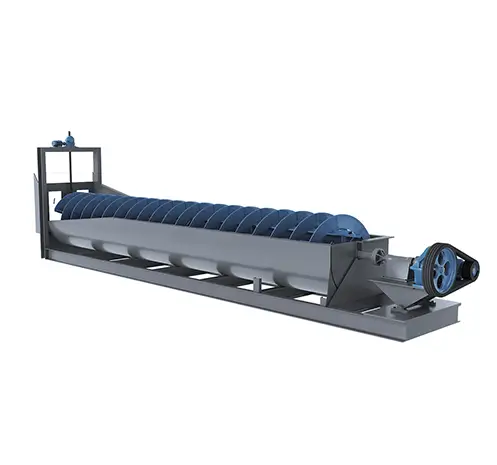
The spiral sand washing machine is driven by a motor, with the impeller rotating slowly via a V-belt and a reducer. Materials (such as sand, gravel, and ore) enter the washing tank from the feed chute and are tumbled and agitated by the impeller to remove impurities from their surface.
- The material is tumbled and agitated within the washing tank by the impeller.
- During this process, collisions and friction occur between the materials and between the materials and the impeller and casing, which helps remove impurities such as mud and stone powder from the material’s surface.
- Lighter impurities and foreign objects are carried away by the water flow and discharged from the drain outlet of the washing tank.
Product Structure
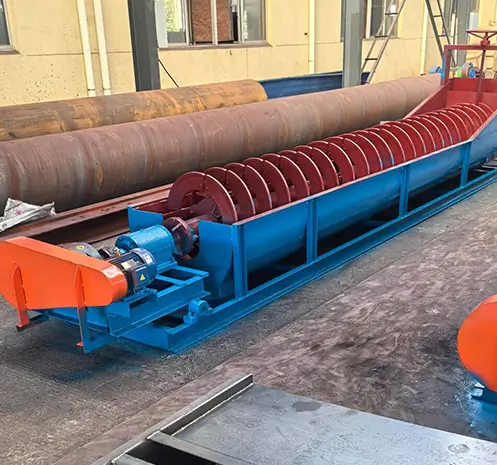
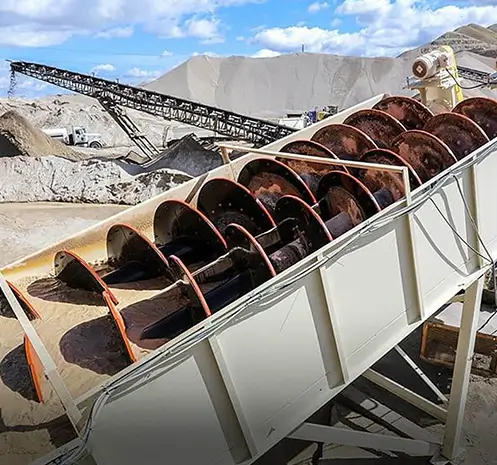
Rotary Spiral Shaft: The rotating shaft is the core component of the coarse aggregate washer. Its inlet end is equipped with blades for scrubbing; the rest of the shaft is conveyed to the outlet by a screw conveyor. Increasing the number of blades on the shaft improves the scrubbing effect; however, increasing the number of blades reduces the throughput.
Washing Tank: The washing tank holds the aggregate to be processed. The rotating shaft is installed inside the tank, where the aggregate is scrubbed and cleaned.
Upflow Classifier: The upflow classifier within the washing tank of the coarse aggregate washer helps optimize machine performance. The upflow helps to remove unwanted lightweight materials such as branches, sticks, and coal lumps with the wastewater.