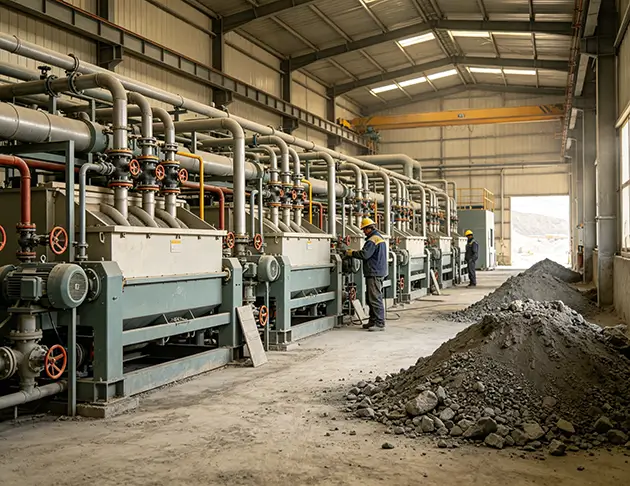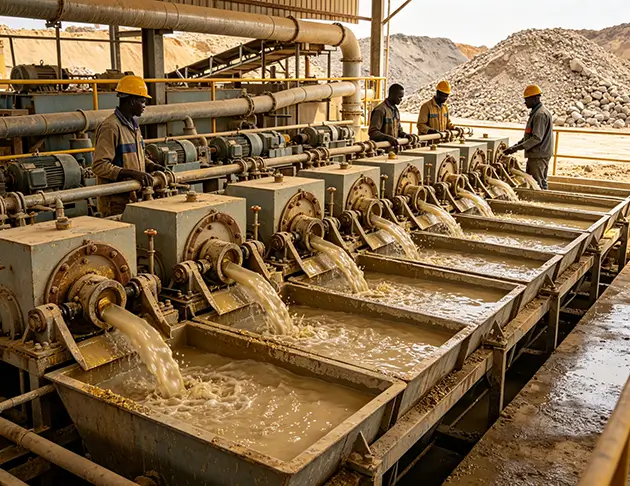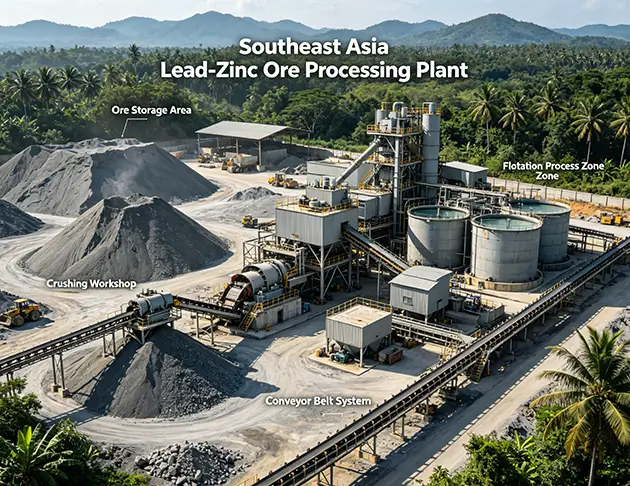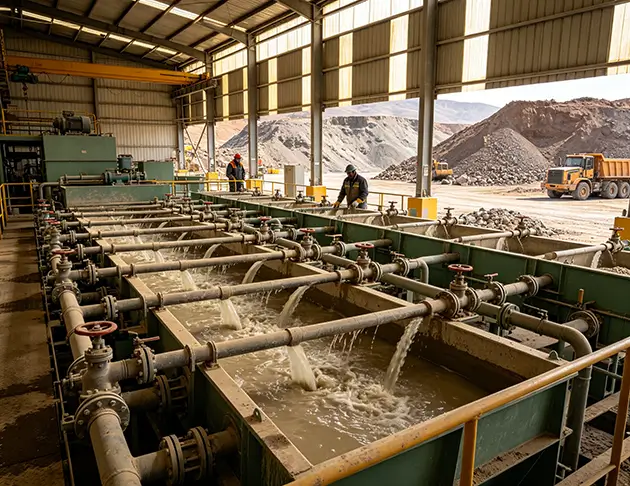
The beneficiation process for various metallic minerals can generally be summarized in the following steps:
1. Ore crushing;
2. Grinding process;
3. Separation technology;
4. Sintering and granulation technology.
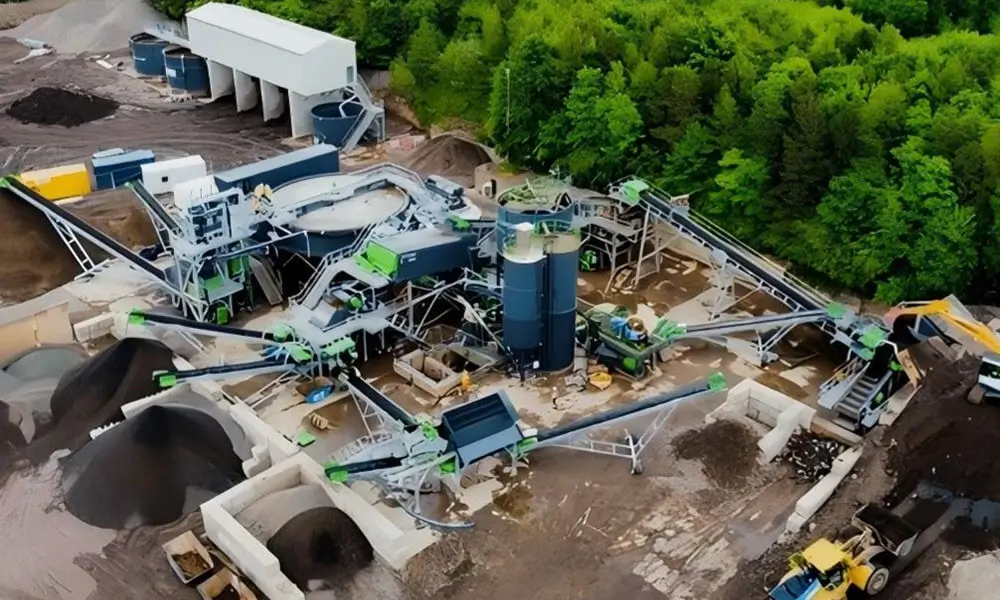
For manganese ore: mechanical separation methods (including beneficiation, screening, gravity separation, high-intensity magnetic separation, and flotation), as well as pyrometallurgical collection and chemical beneficiation methods, are employed.
Flotation is widely used. The full name of flotation is froth flotation. It is a separation method based on the differences in the physicochemical properties of mineral particle surfaces, particularly their floatability.
This method floats the useful minerals to the top, while the useless minerals (i.e., gangue minerals) are discharged as tailings with the slurry. This method is called direct flotation; the reverse is called reverse flotation.
Flotation reagents include collectors, frothers, depressants, activators, pH adjusters, dispersants, flocculants, ETC.
There are various types of flotation machines, such as mechanically agitated, pneumatic, and pneumatically agitated machines.
Our company widely uses flotation to separate finely dispersed metallic minerals, non-metallic minerals, and chemical raw material minerals.
During the flotation process, the floating or sinking of minerals is almost independent of their density. For example, chalcopyrite has a density of 4.2, while quartz has a density of 2.68. This indicates that the heavier chalcopyrite floats easily, while quartz sinks. Studies have shown that the floatability of a mineral is related to its hydrophilicity. Minerals with strong hydrophilicity, that is, minerals that are easily wetted by water, are difficult to adhere to air bubbles and therefore difficult to float. Conversely, minerals with weak hydrophilicity, that is, minerals that are not easily wetted by water, are easy to float.
Therefore, flotation can be described as a mineral processing method based on differences in the hydrophilicity of minerals. The property of a mineral being easy or difficult to float is generally referred to as its floatability. Flotation utilizes the differences in mineral floatability to achieve mineral separation. In modern flotation processes, the application of flotation reagents is particularly crucial because treatment with these reagents can change the floatability of minerals, causing the minerals to selectively adhere to air bubbles, thereby achieving the goal of mineral separation.